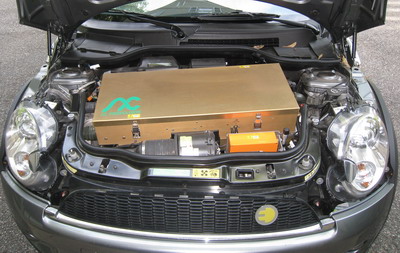
.jpg) For Questions & Answers, see the For Questions & Answers, see theQ&A section at the bottom of this page. Read the entire Journal News coverage at: http://www.lohud.com/apps/pbcs.dll/article?AID=2009307280005 All-Electric CarField testing the first MINI-E all-electric vehicleI picked up my new car on Tuesday, June 23, 2009: an all electric MINI. It is serial number 300, of the total 450 that were built (actually, they call is the "side scuttle number" rather than serial number). I paid to test drive it for 12 months as part of the "field trial," after which the cars must all be returned to BMW/Mini (and probably destroyed).
Q&AThese are actual questions friends have emailed me...
0 to 62 mph in 8.5 seconds is quite respectable. Top speed of 95 mph is adequate. Please tell me that you’ve confirmed that.
Not yet. However, I did find myself cruising along with traffic on I-287 the other day at 80mph. It felt no different from any other car. The biggest noticeable difference is the torque (at any speed) when you
"floor it."
Can you plug it in anywhere? How long does it take to recharge?
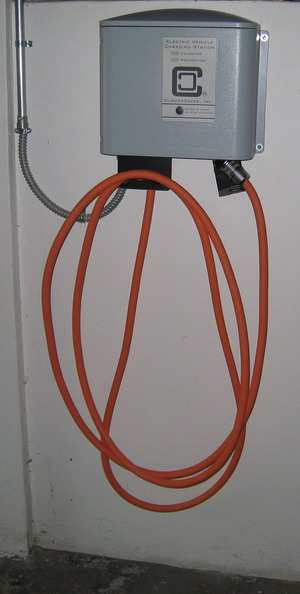
There is a "40-amp" wall box in my garage that charges it relatively quickly
(see photo above). I carry an emergency cable for 120v plug-in, but that draws 12 amps and charges slowly, estimated 24 hrs for a full recharge.
I assume that the 150 mile range was measured at a constant rate of speed, with no stops, and all accessories off. How quickly does the rate of power consumption change when all the accessories are on (A/C, lights, CD, radar detector, microwave, etc.) and the car is driven like I would?
Correct. The actual, practical range is about half that, so it is just an
around-town car. I figure 75+ miles on a charge.
How did you get to be part of the test group?
I applied in 2008, answering many questions (essay questions, like a college admission application). Then they screened me early in 2009 and did a background and credit check (because I need to pay to be part of this elite group – Ha!
Isn't that a sweet irony?)
How long does it take to recharge?
Recharge time on the 40-amp wall box is reportedly 5 hours for a full charge. I plug it in
every night, however, with only a partial charge needed, so I'm not sure.
3 people asked questions about cost:
(a) Amazing. If my calculation is correct, a full charge costs 35 kwh x $0.12/kwh = $4.20. This comes to $4.20/150 miles = $.028/mile. If this is correct, watch out EXXON and the mullahs.
(b) If my calculations are correct, at 0.06$/kwh (our rate in Maine), this car only costs a little over a penny/mile to drive. Amazing! (c) Based on the info, the MINI gets 5 miles per kwh. If electricity costs 20 cents per kwh, your fuel cost is 4 cents per mile. A gas-powered car might get 30 mpg on $3.00/gallon gas, for a fuel cost of 10 cents per mile. So you're saving 60% on fuel costs. The bad news is that you would have to drive 16,667 miles a month to recoup the $12,000 paid to be a test driver for one year.
Unfortunately I don't think it will be that good.
I think I'll get about 100 miles per complete charge and the electricity cost here in Westchester (full cost) is > $.20 per kwh. . . So the MINI-E may be slightly cheaper than gasoline. In one place, the MINI-E reference material says that a full charge is 28 kW-h; in another place they say 35kW-h; on the window sticker it says something else. Therefore, at $.20/kW-h for 35 kW-h charging, the cost would be $7.00 for a full range of about 100 miles, so the cheapest I predict would be about 7 cents/mile (which is probably about the same as a Prius hybrid).
At 204 hp, that’s more hp than my track car (190 hp). What’s the foot-pound equivalent of 220 Newton meters?
According to
http://www.unitconversion.org/energy/foot-pounds-to-newton-meters-conversion.html
the answer would be 162.263672846. For additional information,
see
http://www.bondhus.com/tech-library/body-1b.htm
So, how many miles to the gallon is the Mini Cooper getting?
Well, one way to look at it is simple -- it's electric, so there is no "miles per gallon" calculation possible.
However, the window sticker shows the following numbers for "EPA Energy Estimated Consumption Information": 33 kW-h/100 miles CITY 36 kW-h/100 miles HIGHWAY You can do the math and compare the cost to a gas-powered car.
What's the driving experience like?
At one level, it is not luxurious. After all, the MINI isn't a luxury car: no power seats,
no steering wheel heater, no heated/cooled seats, no GPS, no built-in garage door openers,
etc.
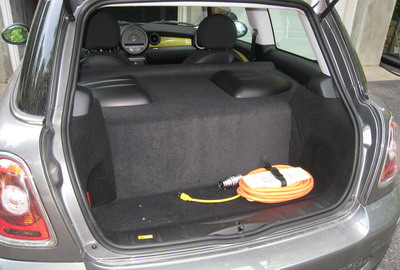
On another level, it is sporty to drive, with a very tight suspension and lots of torque. Finally, in terms of utility, it's not too useful because there is no back seat and no trunk and therefore virtually no storage space. There's room for my briefcase, and that's literally all. (see photo above) Once you adjust to the driving style necessitated by the regenerative braking, it's actually pretty fun. Simply let your foot off the accelerator completely and the car switches into recharging the battery. It feels like you are braking hard, similar to a manual transmission downshift to a much lower gear, and the car literally comes to a stop without touching the brakes! (The brake lights come on, however, to warn motorists behind you while you are decelerating in this mode.)
What is the primary material used to construct the Mini? Carbon fiber?
This is a regular 2008 Mini Cooper that has been modified.
Does that have heat for winter and A/C for summer?
Yes, it has all the regular car capabilities because it is essentially a 2008 model year MINI.
How much range extension would you get with a half hour charge on your 40 amp circuit?
I'm guessing that a 30-minute charge would be about 10% of a full charge, or about 10 miles more range.
How does driving at night effect the overall mileage (using headlights, etc...)
It definitely reduces the range, but I don't know yet how much. Everything that uses electricity will
draw down the battery, even the turn signals. I presume the draw for most appliances is minimal, however,
compared to the 204 hp motor.
How much did you electric bill at home go up this month?
I'll watch this over the course of the 12-month test.
So far I haven't noticed it because it's summer and we haven't needed A/C this
year so generally I've been using less electricity than prior years in the
summer.
From the website http://www.sunywcc.edu/aboutwcc/whats_new/chancellor.htm June 30, 2009 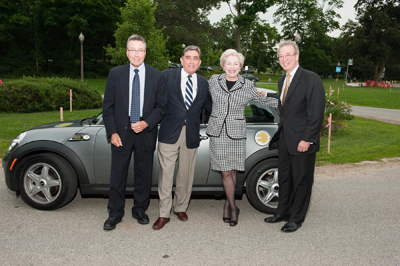 (L-R) Dr. Joseph Hankin, President, Westchester Community College; Westchester County Executive Andrew Spano; Dr. Zimpher; Ted Nygreen, Associate Dean of Mathematics, Computer, Engineering & Physical Sciences and Technologies standing in front of Nygreen’s “Green” Mini E Cooper – powered by a 150 kW (204 hp) electric motor fed by a high-performance rechargeable lithium-ion battery, transferring its power to the front wheels via a single-stage helical gearbox nearly without a sound and entirely free of emissions. From the Journal News Read the entire article in this Gannett newspaper http://www.lohud.com/apps/pbcs.dll/article?AID=2009307280005 July 26, 2009, 2009 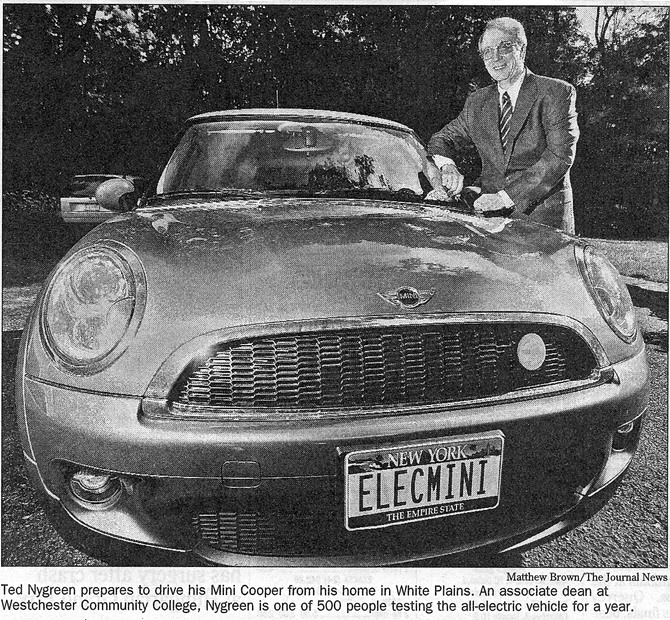 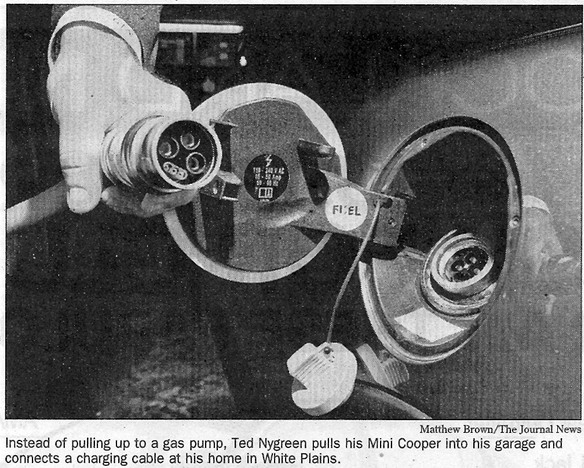 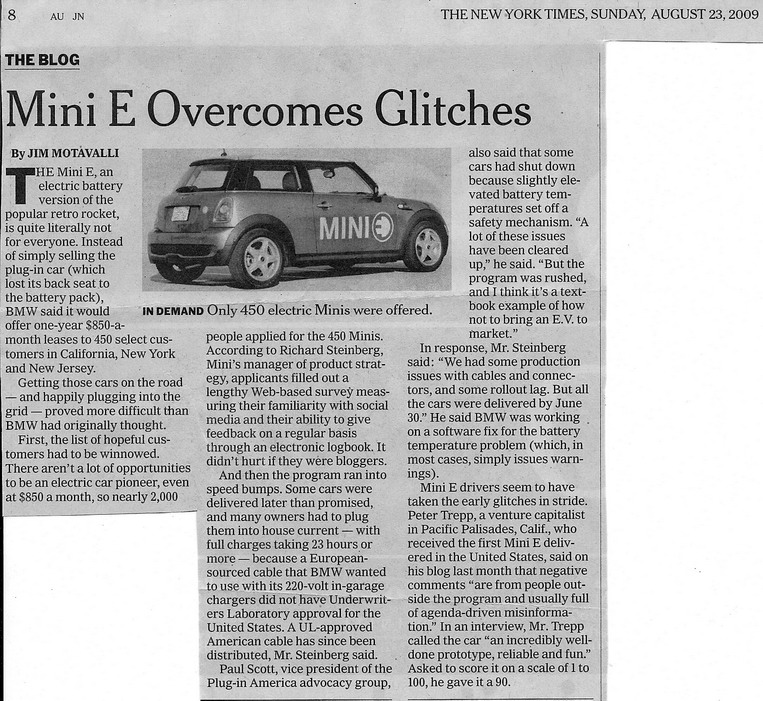
| ||||||||||||
Coverage from MIT: https://slice.mit.edu/2009/07/21/electric-cars/Are Electric Cars the Answer to Energy Woes? Here’s the Lowdown
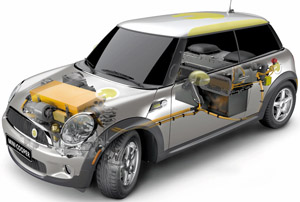
Ted Nygreen ’67 is one of 500 field testers of the first all-electric Mini Cooper (MINI E).
Last month, he began a yearlong trial to provide insight to BMW for when it mass-produces the vehicles.
And he created a Web site to quench curiosity seekers’ thirst for empirical data.
|
.jpg)